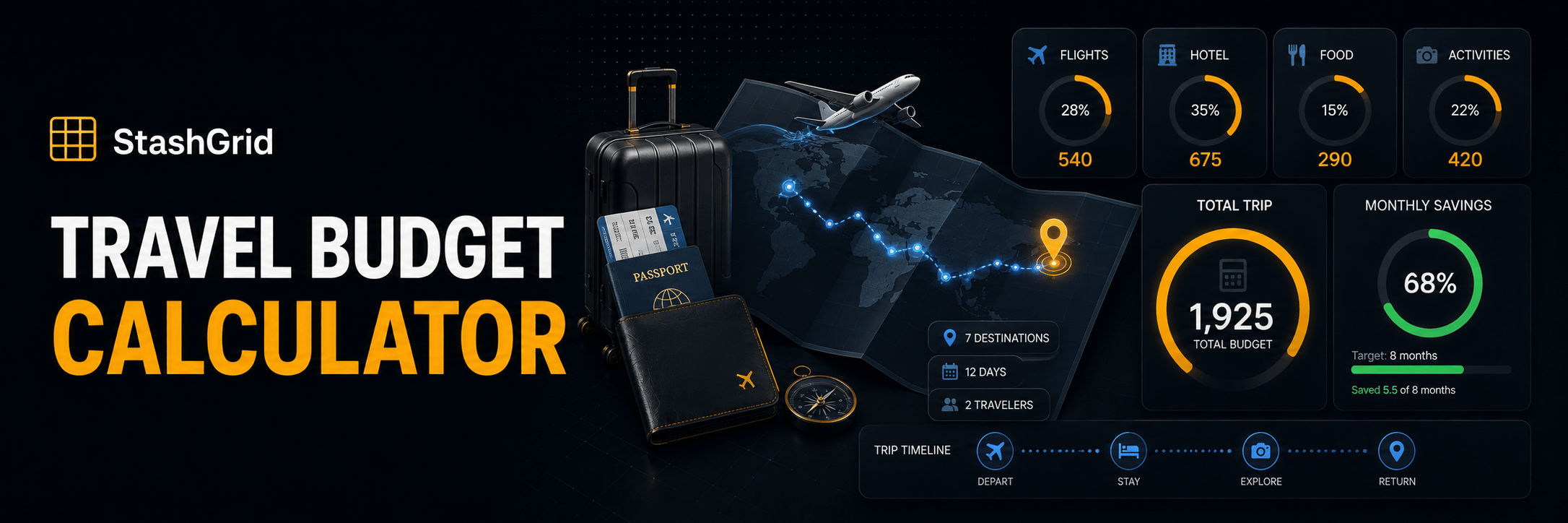
Travel Budget Calculator
Plan your full trip cost — flights, hotels, food, activities, and how much to save per month.
Plan your full trip cost — flights, hotels, food, activities, and how much to save per month.
Most travel budgets are wrong in the same direction for the same reasons. Flights and hotels are easy to price, so they get priced carefully; everything else is estimated loosely or forgotten entirely, and the gap shows up on the credit card statement three weeks later. This section covers the categories that go missing and the mechanics that quietly take a percentage off everything you spend.
Before the trip starts:
During the trip:
Three separate charges apply to spending abroad, and they stack.
Foreign transaction fees. Many cards add around 3% to every purchase made in another currency. Cards without this fee exist and are worth arranging before a trip — on a $4,000 trip that single choice is about $120.
Dynamic currency conversion. When a foreign card terminal or website asks whether you would like to be charged in your home currency, the correct answer is always no. Accepting hands the conversion to the merchant's payment processor at a rate that typically carries a 3–7% markup over the rate your card network would have used. It is presented as a convenience and it is a fee. Choose the local currency and let your own bank convert.
Cash access. Airport exchange desks and hotel front desks offer the worst rates available anywhere, precisely because they are the most convenient. A bank ATM in town, using a card with low or no foreign ATM fees, and withdrawing larger amounts less often, is consistently cheaper. Decline the ATM's own conversion offer for the same reason as above.
Most trip savings come from three decisions, and everything else is noise around them.
When you go. Shoulder season — the weeks either side of peak — often costs substantially less for flights and accommodation while the weather is still reasonable and the lines are shorter. Moving a trip by two weeks can save more than a month of careful daily economizing.
How flexible your dates are. Mid-week departures are usually cheaper than weekends, and avoiding public holidays and school breaks matters more than the day of the week you book on. Flexibility is worth more than timing tricks.
Where you sleep. Accommodation is typically the largest controllable line. The choice between a hotel, an apartment with a kitchen, and a hostel changes not just the nightly rate but the food budget — a kitchen turns two meals a day from restaurant prices into grocery prices, which on a two-week trip is substantial.
Total trip cost is hard to sanity-check. Cost per person per day is not: it is directly comparable against what you know about a destination, against other trips you have taken, and against what other travellers report.
It also makes trade-offs visible. If the daily figure looks high, you can see immediately whether the fix is fewer days, cheaper accommodation, or a different destination — three very different decisions that a single total obscures.
Add 10–15% on top of your estimate for the things you have not thought of. This is not pessimism; it is the observation that unplanned costs are one-directional. Nobody returns from a trip having spent less than expected because of an unexpected refund.
The contingency covers the genuinely unpredictable — a missed connection, a medical visit, a taxi when the last train has gone — and also the predictable-but-unbudgeted: the nice dinner you decide on, the tour you had not planned, the souvenir that costs more than you intended. Keeping it as an explicit line rather than quietly padding every other category is what stops it from being spent before you leave.
It arranges your own estimates into a total, a per-day figure, and a monthly savings target for the date you are aiming at. It does not know current prices for your destination, exchange rates, or what your particular trip will actually cost — those are the figures you supply. Its value is in making sure the categories are all present and the arithmetic is right, which is where most budgets fail long before the estimates do.