Rhyme Finder
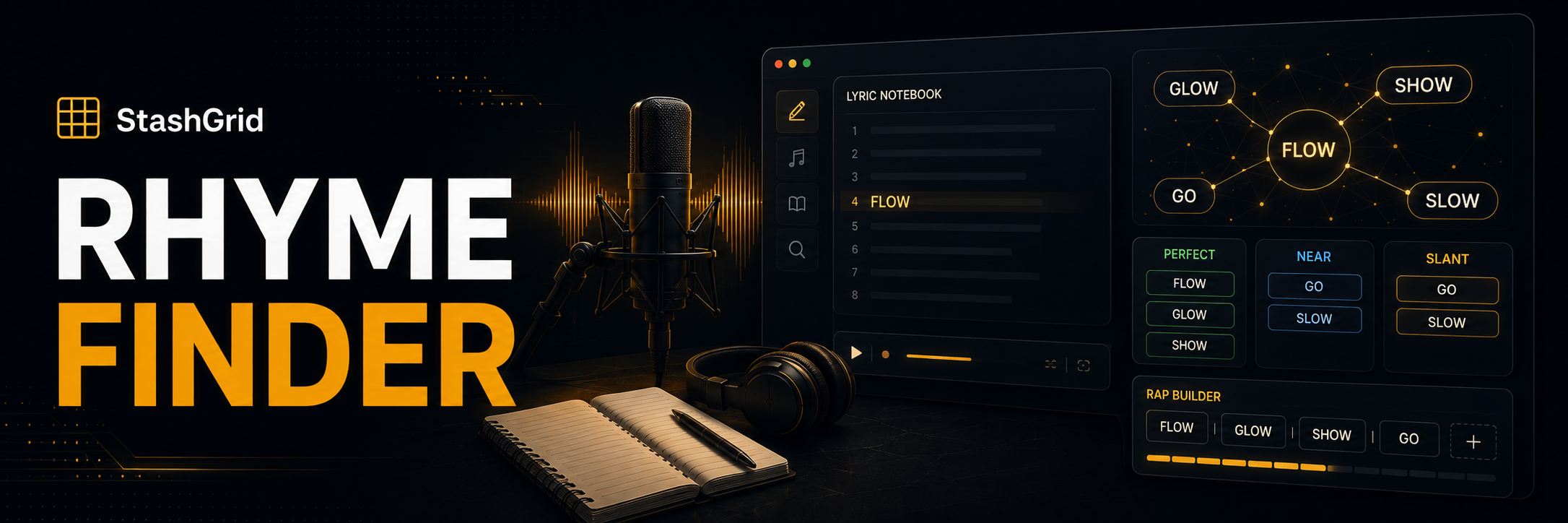
Find perfect rhymes, near rhymes, and slant rhymes for any word — instantly. The free online rhyming dictionary for poetry, songwriting, rap lyrics, and creative writing. Click any result to copy it.
Kinds of rhyme, and how to use them
A rhyme finder returns words that sound alike. Which of them is the right word depends on what kind of rhyme you are after, and "perfect rhyme" is frequently the wrong answer — in songwriting especially, the near misses do more work than the exact matches.
Perfect rhyme
Two words rhyme perfectly when everything from the stressed vowel onward matches, and the consonant before it differs: cat and hat, station and nation. If the leading sound matches too — great and grate — it is an identity rather than a rhyme, and using one usually sounds like a mistake.
Perfect rhymes are strong, closed and final. That makes them excellent for the last line of a stanza or the end of a chorus, and slightly heavy everywhere else.
Slant rhyme, and why it is often better
A slant rhyme (also called near, half or oblique rhyme) matches partially: shape and keep, worm and swarm, home and alone. The related devices are assonance, where only the vowel matches (light, fine), and consonance, where only the consonants do (blank, think).
Slant rhyme is the default in most contemporary songwriting and a great deal of modern poetry, for a practical reason: it removes the constraint that produces bad lines. A writer committed to perfect rhyme eventually reaches for whatever word fits the sound, and the meaning bends to accommodate it. Slant rhyme keeps the musical echo while leaving the vocabulary open.
It also carries a different feeling. Perfect rhyme resolves; slant rhyme leaves a slight tension unresolved, which is often exactly what a verse needs before the chorus arrives.
Masculine, feminine, and multisyllabic
- Masculine rhyme falls on a single stressed syllable: de-CIDE / in-SIDE. Punchy and conclusive.
- Feminine rhyme is a stressed syllable followed by an unstressed one: LIGHT-ly / NIGHT-ly. Softer, and it keeps a line moving rather than stopping it.
- Multisyllabic rhyme extends across several syllables at once. This is the backbone of technical rap writing, where whole phrases are matched rather than single words, and it is what makes a line sound intricate rather than merely rhymed.
Alternating masculine and feminine endings is one of the oldest ways to keep a poem from sounding mechanical.
Spelling lies about sound
English orthography is not a guide to pronunciation, and rhyme lives entirely in sound. Through, though, tough, thought and thorough share five letters and rhyme with none of each other. Meanwhile eight rhymes with plate, and rough with stuff, despite no shared ending.
Words that look like they should rhyme but do not are called eye rhymes — love and move, comb and bomb. Older poetry uses them deliberately, and occasionally they are historical rhymes that stopped working as pronunciation shifted. In a modern lyric an eye rhyme usually reads as an error, because the listener never sees the spelling.
Accent matters too. Whether two words rhyme can depend on where the singer is from, and a rhyme that works in one variety of English can fall flat in another.
Rhyme schemes worth knowing
- AABB — couplets. Fast, memorable, and the most obviously "rhymed" of the schemes. Natural for comic verse and children's writing; can sound sing-song in serious work.
- ABAB — alternating. The distance between rhymes softens them, which makes this the most flexible general-purpose scheme.
- ABCB — the ballad scheme, rhyming only the second and fourth lines. Half the rhyme constraint, most of the musical effect. This is the workhorse of folk song and hymn, and it is usually the right starting point for a verse.
- AAAA — monorhyme. Insistent and hard to sustain without strain, but powerful in short bursts.
Choruses tolerate tighter schemes than verses, because repetition is the point. Verses generally want more room.
The tell of a forced rhyme
Forced rhyme is almost always visible in the syntax rather than the sound. When a line inverts its natural word order to land a rhyme at the end — putting the verb last, or reaching for an adjective nobody would otherwise use — the listener hears the machinery.
Two fixes are usually available. Change the other line so a different rhyme is needed; the problem is often not the word you cannot find but the word you committed to two lines earlier. Or accept a slant rhyme and keep the sentence intact. The second is nearly always the better trade.
Words with almost nothing to rhyme with
Orange, purple, silver and month are the famous cases. The usable approaches are the same for all of them: use a two-word near rhyme (door hinge for orange is the well-worn example), move the word off the end of the line where it carries meaning without needing a partner, or restructure so it sits in the middle and something easier takes the rhyme position.
Put another way: a word being hard to rhyme is a reason to change where it sits, not a reason to change the word.
A practical way to work
- Write the meaning first, rhyme second. Get the thought down in plain words, then find sounds that let you keep it. Reversing this produces lines that rhyme and say nothing.
- Rhyme backwards. If a rhyme is proving impossible, the line to change is usually the earlier one.
- Say it aloud. Rhyme is heard, not read, and a rhyme that works on the page can collapse in the mouth.
- Watch the stress. Two words only truly rhyme when the matching sounds carry the same emphasis — which is why a rhyme can feel slightly off even when the letters line up.
- Collect options before choosing. Scan the full list, pick three or four candidates that could plausibly mean something in your line, and write the line for each. The best rhyme is rarely the first one.
Frequently asked questions about rhymes
What is the difference between a perfect rhyme and a near rhyme?
A perfect rhyme shares the same vowel sound and all ending consonants from the last stressed syllable — "cat" and "hat", "love" and "above". A near rhyme (also called half rhyme or slant rhyme) shares similar but not identical sounds — "moon" and "on", "seem" and "name". Near rhymes are widely used in modern poetry and rap because they sound more natural and give writers far more options.
What is a slant rhyme?
A slant rhyme (also called an imperfect rhyme or near rhyme) is when two words sound similar but don't rhyme exactly. Emily Dickinson pioneered slant rhymes in the 1800s. In rap and hip-hop, slant rhymes are essential — artists like Eminem and Kendrick Lamar use complex slant rhyme patterns to maintain flow while conveying richer meaning than strict perfect rhymes allow.
What words rhyme with "orange"?
Orange is famously difficult to rhyme in English — there are no common perfect rhymes. However, near rhymes and slant rhymes include: storage, porridge, forage, and the rare botanical term "sporange." Experienced lyricists work around orange using multi-syllable slant rhymes — for example, "door hinge" sounds like a near rhyme with "orange" when spoken naturally in a rap verse.
Can I use this rhyme finder for rap lyrics?
Absolutely. The near rhymes and slant rhymes tabs are especially useful for rap and hip-hop, where strict perfect rhymes can feel forced or limit what you can say. Modern rap relies on multi-syllable rhyme schemes, internal rhymes, and slant rhymes. Browse all three categories and click any word to copy it instantly to your clipboard.
What words are hardest to rhyme in English?
The most notoriously difficult words to rhyme perfectly in English are: orange, silver, purple, month, angel, and chimney. None of these have common perfect rhymes. This is exactly why near rhymes and slant rhymes exist — they give poets and lyricists creative options when perfect rhymes would be impossible or forced-sounding.
Does this rhyme finder work for languages other than English?
The current version covers English rhyme patterns. Rhyme rules vary significantly across languages — Spanish rhymes by vowel sound, French by written ending, Italian by both. We're building language-specific rhyme finders for Spanish, French, German, Portuguese, and Italian. Each will be available at its own subdomain (e.g. es.rhyme.stashgrid.site) with the same clean, fast interface.